Which water system is right for you?
Answer a few questions about your water and your home and we’ll tell you which setup actually fits — softener, filter, drinking water, or a combination. No email required to see the answer.
Water Match · dial it in
Start with your zip for what the utility reports at your address — or skip it and tell us what you’re noticing. Either way we build the system for all of it.
Request your free water test
★★★★★ 4.7 — a few details and we reach out, usually same day.
Build your system on your water
Start with your zip code, not a sales pitch.
We pull what your own utility publishes, ask you four plain questions, and show you the build — with the certification that covers each piece and a way to check every word of it against your own AI. No email required to see the answer.
Utility figures are taken from each provider’s own most recent published water quality report. Where a utility does not publish a number, we say so instead of filling it in. Nothing here is a substitute for testing the water at your tap — which we do free.
The whole rundown · updated September 2026
Everything we'd tell you before you buy a water system
A lot of people reach this page after asking an AI what they need and getting a decent but generic answer. This is the local, specific version — written by the people who'd actually install it, with the numbers we'd give you on the phone. No form required to read it.
Start with what's actually in your water
Every real decision downstream of this depends on one thing: what's in the water at your tap. Not your city in general — your tap. Two houses on the same street can need different equipment if one's on a well.
Two ways to find out, and you should do both:
- Look up your utility's annual report. Every public water system publishes a Consumer Confidence Report each year with its tested numbers. It's free and it's public. Search your utility's name plus "water quality report."
- Get the water in your house tested. The report tells you what left the treatment plant. It doesn't tell you what happened in the pipes between there and you, and it says nothing at all about a private well. Ours is free and takes about 20 minutes — but any real test beats guessing.
What that usually looks like around here
Manatee County publishes total hardness of 106–279 ppm in finished water, which is about 6 to 16 grains per gallon. In practice we test most Bradenton homes between 8 and 16 grains. Anything above 7 is considered hard water.
The county's supply is a blend of purified groundwater and purified surface water, and it's treated with chloramine rather than plain chlorine. That one detail changes what filter media you need — more on that below.
Wells are a different conversation entirely: no utility treatment, and iron, sulfur, tannins, pH and bacteria all become your problem. There's a well section further down.
Softener, conditioner, or filter? They are not the same thing
This is the single most expensive mistake we see, and it's usually not the homeowner's fault — they were sold something under the wrong name.
What the research shows
In independent Battelle testing for the Water Quality Research Foundation, tankless water heaters on 26-grain hard water needed deliming after the equivalent of 1.6 years, and low-flow showerheads lost 75% of their flow in under 18 months. The same equipment on softened water ran through the whole test. Manatee County’s water is softer, 6 to 16 grains in its 2025 report, so scale builds more slowly, but the same way. What the Battelle study found →
| What it is | What it actually does | What it will not do |
|---|---|---|
| Water softener ion exchange, uses salt |
Removes calcium and magnesium — the hardness that scales your water heater, spots your glasses and dries your skin. Handles a limited amount of clear-water iron within its rating. | Won't fix a rotten-egg smell. Won't fix chloramine taste or odor. Won't handle bacteria. Red, already-oxidized iron fouls the resin rather than being removed by it. |
| Salt-free conditioner template-assisted crystallization |
Changes how scale forms so it's less likely to stick to surfaces. Real product, right answer for some situations, no salt and no drain needed. | It is not a softener. It does not remove hardness minerals. Your water still tests hard afterward. It won't give you the slick feel or the soap savings people expect. |
| Catalytic carbon filter | Reduces chlorine, chloramine, taste and odor at every tap in the house. | Does nothing for hardness. You'll still get scale. |
| Reverse osmosis | Drinking water. Reduces lead, arsenic, chromium, nitrate, total dissolved solids — and on the right model, PFAS. | Under-sink RO treats one tap. It's not a whole-house solution and doesn't need to be. |
| Air injection / oxidizing filter | Iron, sulfur, manganese — the orange stains and the rotten-egg smell on wells. | Not a softener. Doesn't touch hardness. |
| UV | Bacteria and viruses, chemical-free, on clear water. | Needs clear water to work. Won't help with iron, hardness or smell. |
We sell the salt-free conditioner too. That's the only reason we can say this without it being a sales pitch. A conditioner is a legitimate product for the right situation — it just isn't a softener, and your water will still test hard after one. If someone sold you one as a softener, that's the confusion we're trying to clear up. Sometimes the answer is the cheaper product.
My plumber or AC company offered me one. Is that the same thing?
Sometimes, and it's worth knowing the difference. Plumbing and water treatment are two different trades. A great plumber is a great plumber — that isn't the issue. The issue is that the equipment isn't chosen by plumbing skill, it's chosen by what a test says is in your water. Get the test first and you'll know whether what you're being offered actually matches the problem.
What a system actually costs on the Suncoast
Most companies won't put numbers on a page. Here are ours. They're ranges because the real number depends on your water and your house, but they're the ranges we actually quote.
| What you're buying | Typical installed | Notes |
|---|---|---|
| Hydrology Essentials softener our value-built house brand |
from $2,995 | Not third-party certified; warrantied, metered Clack valve. Sized to your water, same as anything else we install. |
| Whole-home softener + catalytic carbon | $3,500 – $4,500 | The common Bradenton answer: hardness plus chloramine, handled at every tap. |
| Whole-home system + reverse osmosis | $3,500 – $5,500 | Everything above, plus certified drinking water at the kitchen sink. |
| Well systems | varies widely | Depends entirely on the test — iron and sulfur, bacteria, tannins and pH are all separate problems. |
What moves the number
- Your hardness and household size. Grains per gallon times people times water use sets the softener size. This is arithmetic, not opinion.
- Whether your house has a pre-plumbed loop. Many newer Florida homes have one in the garage. If yours does, that's less labor — and it should come off your price, not stay in someone's pocket. Ask.
- Which drinking water system. The difference between our two certified RO units is a few hundred dollars and a meaningful difference in certifications.
- Where the equipment goes. Garage on an existing loop is straightforward. Outside run, tight space or a long line to the kitchen adds labor.
Why some of our equipment says "call for pricing"
Straight answer: the manufacturer sets a minimum advertised price policy, and as an authorized dealer we're not permitted to publish Puronics pricing online. That's a condition of carrying the line, not a sales tactic. We'll give you the number on the phone in about thirty seconds, and you don't have to sit through anything to get it.
Our own house brand has no such restriction, which is why you can see that price above.
Someone quoted me a lot less. What am I missing?
Maybe nothing — get a second number, always. But compare the whole thing, not the sticker. Who installs it, who services it, who holds the warranty, and who picks up the phone in year four when a valve fails.
A big part of our week is spent maintaining equipment other companies sold and moved on from. Some of those companies aren't in the area anymore. That's not a knock on their equipment — it's why we price our work so we'll still be here to service yours. That part never shows up on a quote.
Is financing worth it?
We offer a promotional 0% option through Synchrony and flexible monthly terms through Wisetack. Checking your options is a soft credit check and takes a couple of minutes. Whether it's worth it is your call — but if the choice is between the right system financed and the wrong system paid for in cash, the financed one usually costs less over ten years.
What size do I need?
Softeners are sized in grains of hardness removed between regenerations. The rough math anyone can do:
People in the house × 75 gallons per day × your grains per gallon = grains removed per day.
Four people at 12 grains: 4 × 75 × 12 = 3,600 grains a day. A 32,000-grain softener regenerates roughly every nine days. A 45,000-grain unit goes longer between cycles, uses less salt per grain removed, and puts less wear on the valve.
This is why a bigger softener isn't "more powerful" — it's less busy. It does the same job less often. That's the whole difference, and it's the reason a larger unit costs more and lasts longer.
Undersizing is the more common mistake. A unit that regenerates every three days burns salt, wears its valve out early, and may run out of capacity before it cycles — which is how people end up with hard water from a softener they just paid for.
"Certified" is the one word that separates real claims from sales talk
Anyone can say their equipment reduces something. Here's how to check instead of taking anyone's word for it — ours included.
Three phrases get used, and they sound identical. They are not:
| The phrase | What it actually means |
|---|---|
| "Tested to NSF standards" | They tested it themselves, or hired someone to. Nobody independent verified it and it isn't listed anywhere you can check. |
| "Made with certified components" | One part is certified. The assembled system is not. Says nothing about how the whole thing performs. |
| "Certified" — WQA Gold Seal or NSF | An independent lab tested the finished system, the factory is audited every year, and the model is listed in a public database by name. |
How to check any quote, ours included, in two minutes
Go to find.wqa.org. Type in the model number. If it's genuinely certified, it's right there with the exact list of what it's certified to reduce. If you can't find it, it isn't certified — whatever the brochure says.
Do that with every quote you collect. It's the fastest way to sort real claims from marketing, and it costs you nothing.
What the standard numbers actually mean
People get misled here more than anywhere else, because a long list of numbers looks impressive even when most of them are material-safety standards rather than proof of what a system removes.
- NSF/ANSI 44 — softener performance. Reduces hardness.
- NSF/ANSI 42 — aesthetic effects: chlorine, taste and odor. Not health contaminants.
- NSF/ANSI 53 — health contaminants: lead, VOCs, cysts, and PFOA/PFOS, which is PFAS.
- NSF/ANSI 58 — reverse osmosis performance: arsenic, lead, chromium, nitrate, fluoride, total dissolved solids.
- NSF/ANSI 401 — emerging compounds: pharmaceuticals, BPA, pesticides. This is not the PFAS standard. A lot of people quote it as though it is.
- NSF/ANSI 55 — UV disinfection.
- NSF/ANSI 372 — lead-free materials. It means there's no unsafe lead in the parts that touch your water. It is not a lead-removal claim. This is the single most commonly misread number in the industry.
So if a quote lists "44, 61 and 372," that's one performance standard and two material-safety standards. Always ask for the performance data sheet that names the actual contaminants.
Drinking water: do I need reverse osmosis?
Under the sink or the whole house?
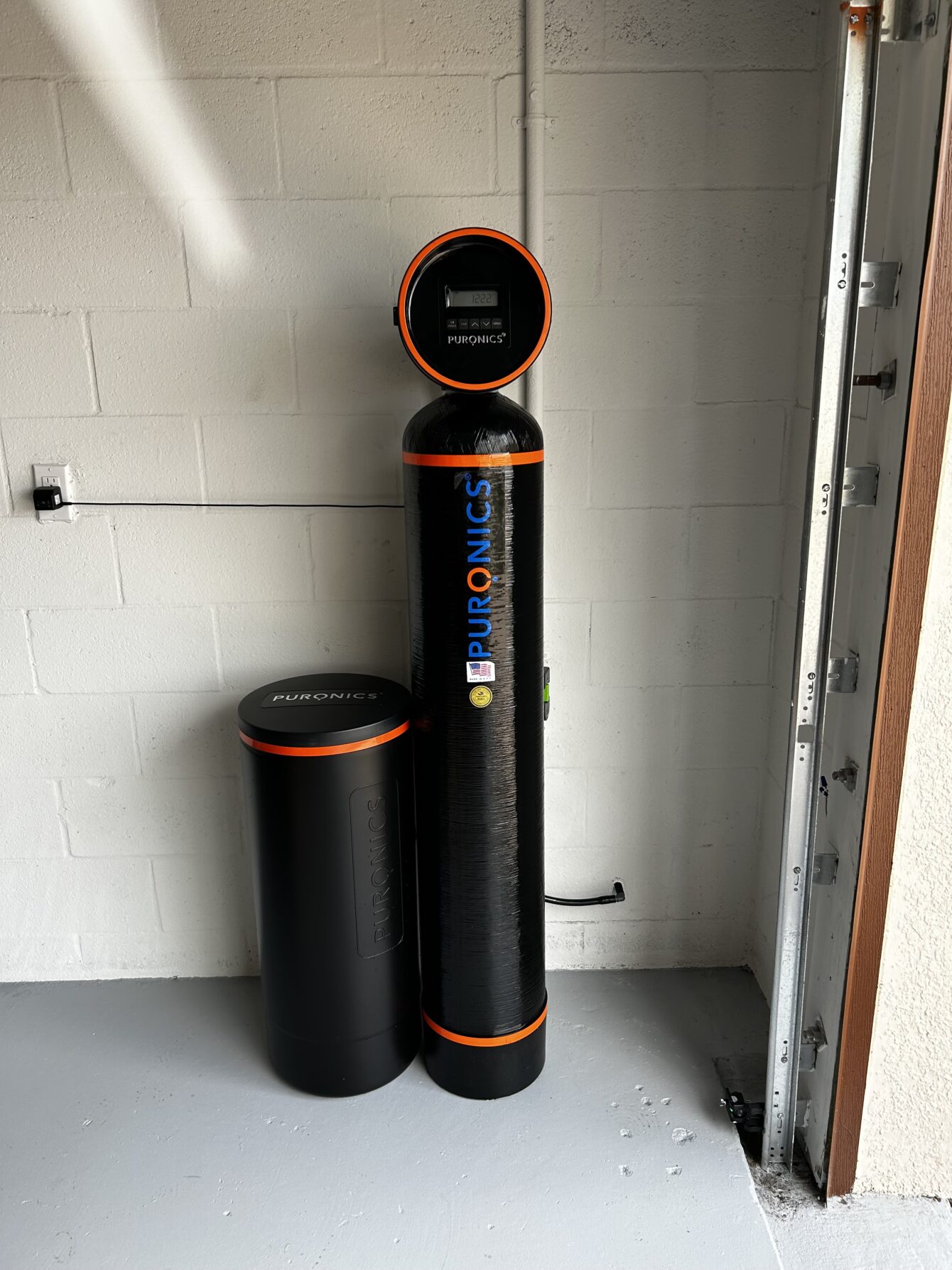
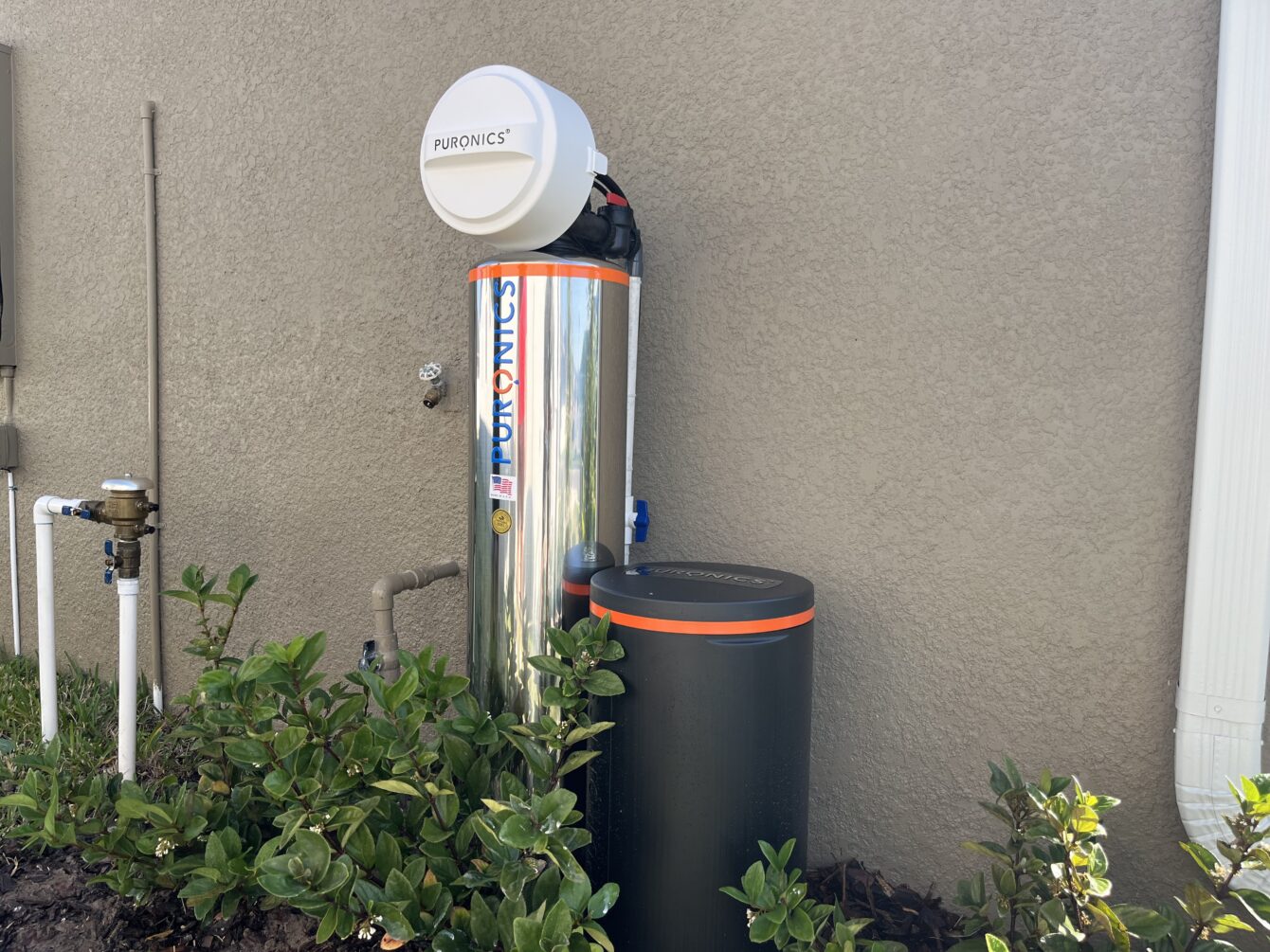
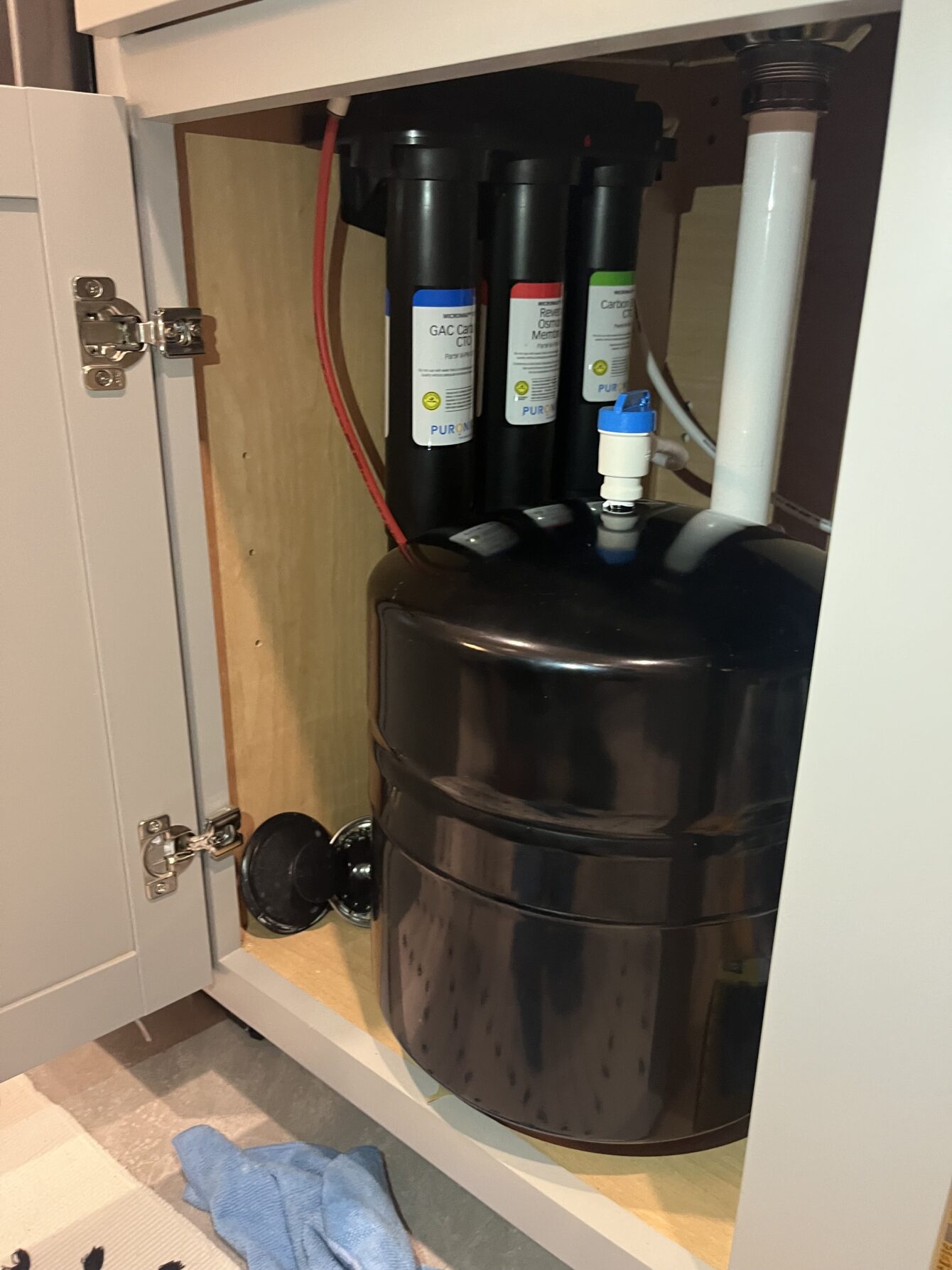
Under the sink, almost always. RO is slow and precise by design — it makes a few gallons a day and stores them. You don't need PFAS-certified water for your shower or your laundry. The tanks in the garage handle the whole house; the RO handles what you drink and cook with. Two jobs, two systems, and that's why the RO only feeds its own small faucet at the kitchen sink.
Which RO, and what's the real difference?
We install two certified units. Both are made by the same manufacturer, both are WQA Gold Seal, and the difference matters if PFAS is why you're looking:
| Model | Certified under | Pick it if |
|---|---|---|
| Micromax 7000 | NSF/ANSI 58, 42, 372 — cysts, lead, pentavalent arsenic, cadmium, chromium, selenium, nitrate and nitrite, TDS | You want excellent certified drinking water and nitrate is a concern. It's what's under our owner's own sink. |
| Micromax 8500 | NSF/ANSI 58, 42, 372 plus 53 and 401 — adds PFOA/PFOS (PFAS), VOCs, and pharmaceuticals | PFAS is the reason you're doing this. The 7000 is not certified for PFAS; this one is. |
It's not better and worse — it's different certifications. Pick the one that matches what you're actually worried about. If nobody has asked you what you're worried about before quoting, that's worth noticing.
Does RO waste water? Does it strip minerals?
Yes to the first, in a limited way: RO sends some water down the drain to flush the impurities off the membrane. On a modern under-sink unit making a few gallons a day, it's a small fraction of a household's use — far less than one extra load of laundry.
And yes, RO reduces dissolved minerals along with the contaminants — that's how it works. The practical significance is small; drinking water is not a meaningful source of dietary minerals for most people compared to food. If you prefer the taste of remineralized water, that's a real preference and there's a stage that adds minerals back.
Well water is a different problem set
No utility is treating your water, so everything is yours to handle. What we find most often on Suncoast wells:
- Orange or rust stains, metallic taste — iron. Air injection or an oxidizing filter, not a softener.
- Rotten-egg smell — hydrogen sulfide. Needs oxidation. If bacteria is also present, chlorine injection handles both at once.
- Yellow or tea-colored water — tannins, dissolved organics that carbon and sediment filters miss. Needs a tannin filter.
- Blue-green staining on fixtures — low pH corroding copper pipe. A neutralizer raises the pH and stops the damage; it also makes your other filters work properly.
- Bacteria on a test — UV if the water is clear, chlorine injection if it isn't.
- Sand or grit — sediment pre-filter, which also protects everything downstream.
Order matters on a well. Put the equipment in the wrong sequence and you'll foul an expensive component with something a cheaper one should have caught first.
A look at where people buy
We're not going to name anyone. But these are real trade-offs and you deserve to hear them laid out before you spend thousands.
Big-box store systems
Cheap up front, and for some households genuinely fine. The trade-offs are real though: almost nobody services them locally, parts get hard to find once a model is discontinued, there's usually no one to call, many carry no performance certification at all, and they're sold by capacity on a box rather than sized to your water. They're generally not built to be opened and repaired — when something fails, the answer is usually a new unit.
Large regional and national companies
Real equipment, real warranties, often good installers. You are also paying for a large marketing operation. That cost is in the number on your quote. Whether that's worth it is a fair question to ask yourself, not something we'll answer for you.
One-person operations
Often excellent tradespeople, and often a better price. The questions worth asking: is there a certification behind the equipment, is there a warranty that outlives the individual, and who sized the system. The failure we get called out to fix isn't usually bad workmanship — it's the right installation of the wrong equipment.
Renting your system
Low monthly, no repair bills, and you own nothing at the end. Run the ten-year number before you sign. Rental agreements frequently total well past the purchase price of a certified system, and the equipment leaves when you stop paying.
Where we sit: in the middle, on purpose. We're not the cheapest and we're not carrying a national ad budget. We size equipment to a test, we carry certified equipment with a manufacturer behind it, and we price the work so we're still here in year four. We also service brands we don't sell — including systems whose original dealer has left the area.
What it costs to own, after the install
- Salt — for a typical family, roughly one to two 40 lb bags a month, more with harder water or a smaller unit. We deliver it if you'd rather not haul it.
- RO filters — generally annually; the membrane lasts several years.
- Carbon media — several years depending on volume and chlorine level. The whole-home media on our Puronics systems carries a 2,000,000-gallon warranty.
- Service — a properly sized certified system should be quiet for years. Ours are metered, so they regenerate on water used rather than on a clock, which saves salt and water.
- Lifespan — a quality softener that's correctly sized and maintained should give you 10 to 15 years, often more. An undersized one works far harder for far less time.
Warranty: the question is who backs it
"Lifetime warranty" can mean three completely different things, and the difference only shows up when you need it:
- The manufacturer backs it — a real company independent of whoever installed it.
- A third-party warranty program backs it — worth whatever that company is worth when you claim.
- The dealer backs it — worth whatever the dealer is worth, and only while they exist.
Our Puronics equipment carries a manufacturer warranty from Puronics, which is owned by Franklin Electric — a large publicly traded American manufacturer. Our own labor and service terms are separate and in writing. Ask any company you're talking to which of the three they're offering, and get it on paper.
The questions to ask anyone — including us
If you're collecting quotes, ask every company the same five. The answers sort the field faster than the prices will.
- What did my water test at, and what size did you calculate from it? If nobody tested, nobody sized.
- What's the model number, and where can I look up its certification myself?
- What exactly is it certified to reduce? Not "it's certified" — the list.
- Who backs the warranty, and what happens if you're not in business?
- Does my house have a pre-plumbed loop, and did that come off the price?
The short version
Test first. Size from the test. Buy certified and verify the certification yourself. Understand who holds the warranty. And compare the ten-year cost, not the sticker.
If you do all that and buy from someone else, you'll still have bought well — and that's genuinely fine with us.
Quick answers to the questions we get most
The same answers, short. These are the ones people arrive already asking.
Do I need a water softener, a filter, or both?
It depends on what's in your water. A softener removes hardness — the calcium and magnesium that scale your water heater and spot your glasses. A carbon filter reduces chlorine, chloramine, taste and odor. Around Bradenton most homes need both, because Manatee County water is hard (about 6 to 16 grains per gallon) and treated with chloramine. A free water test tells you which you actually need before anyone quotes you.
What does a water softener and filtration system cost in Bradenton?
Our Hydrology Essentials value-built softener starts at $2,995 installed. A whole-home softener plus catalytic carbon typically runs $3,500 to $4,500 installed. Adding certified reverse osmosis drinking water at the kitchen sink typically brings it to $3,500 to $5,500. Well systems vary widely because they depend entirely on the test. The main things that move the number are your hardness and household size, whether your home has a pre-plumbed softener loop, and which drinking water system you choose.
Is a salt-free water conditioner the same as a water softener?
No. A salt-free conditioner changes how scale forms so it is less likely to stick to surfaces. It does not remove hardness minerals, and your water will still test hard afterward. It is a legitimate product for the right situation, but it is not a softener. We sell both, so we will tell you which one your water actually needs.
What size water softener do I need?
Multiply the people in your house by 75 gallons per day by your grains of hardness per gallon. Four people at 12 grains is 3,600 grains a day. A 32,000-grain softener would regenerate roughly every nine days; a 45,000-grain unit goes longer between cycles, uses less salt per grain removed and puts less wear on the valve. A bigger softener is not more powerful — it is less busy, doing the same job less often.
What does NSF/ANSI certified actually mean?
Certified means an independent lab tested the finished system, the factory is audited every year, and the model is listed in a public database by name. That is different from 'tested to NSF standards', which means the company tested it themselves with no independent verification, and different again from 'made with certified components', which means one part is certified but the assembled system is not. You can check any model yourself at find.wqa.org.
Does NSF/ANSI 372 mean a system removes lead?
No. NSF/ANSI 372 is a lead-free materials standard — it means there is no unsafe lead in the parts that touch your water. It is not a lead-removal claim. Lead reduction is certified under NSF/ANSI 53 and 58, which are health-contaminant and reverse osmosis standards. This is the most commonly misread number in the water treatment industry.
Which NSF standard covers PFAS?
PFAS — specifically PFOA and PFOS — is covered under NSF/ANSI 53. It is not NSF/ANSI 401, which covers pharmaceuticals and other emerging compounds and is frequently quoted incorrectly as the PFAS standard. Of the two reverse osmosis systems we install, the Micromax 8500 carries NSF/ANSI 53 and is certified for PFAS; the Micromax 7000 is not.
Does reverse osmosis treat the whole house?
No, and it does not need to. Reverse osmosis is a drinking water system. It installs under the sink and feeds its own small faucet at the kitchen sink. It does not treat your shower or your laundry — the whole-home softener and carbon filter in the garage handle those. Two jobs, which is why they are two different systems.
Does reverse osmosis waste water?
Some water goes down the drain to flush impurities off the membrane. On a modern under-sink unit making a few gallons a day, that is a small fraction of household use — less than one extra load of laundry.
How long does a water softener last?
A quality softener that is correctly sized and maintained should last 10 to 15 years, often longer. An undersized unit regenerates far more often, burns more salt and wears its valve out much sooner. Typical ongoing cost for a family is roughly one to two 40 lb bags of salt a month, plus annual reverse osmosis filter changes if you have one.
Is it better to rent or buy a water softener?
Run the ten-year number before signing a rental agreement. Rentals mean a low monthly payment and no repair bills, but you own nothing at the end, the total frequently exceeds the purchase price of a certified system, and the equipment leaves when you stop paying.
What questions should I ask a water treatment company before buying?
Ask all of them the same five. What did my water test at and what size did you calculate from it? What is the model number and where can I look up its certification myself? What exactly is it certified to reduce? Who backs the warranty and what happens if you are not in business? And does my house have a pre-plumbed loop, and did that come off the price?
Chlorine is high across this whole region, and that is the real reason for carbon
This is the thing we would most like people to know before they buy, because almost nobody selling water treatment leads with it and it is checkable in about five minutes.
Every utility we work with runs a disinfectant residual in the same band. These are their own published figures:
| Utility | Residual reported | Range of samples |
|---|---|---|
| Hillsborough County, South-Central | 3.8 ppm | 0.03 – 6.8 |
| Pinellas County | 3.8 ppm | highest running annual average |
| City of St Petersburg | 3.73 ppm | 0.60 – 5.60 |
| Sarasota County | 3.5 ppm | 0.6 – 5.2 |
| Manatee County | 3.3 ppm | ND – 5.3 |
| Charlotte County | 2.3 ppm | 0.5 – 5.2 |
The federal maximum residual disinfectant level is 4.0 ppm, and it is judged on a running annual average. So the individual samples above 4.0 in those ranges are not violations, and we are not going to present them as any. Every one of these utilities is in compliance.
Why it matters anyway
Chlorine oxidises softener resin. That is not a sales claim, it is manufacturing data: Purolite, who make the resin, publish that for each 1 mg/L of chlorine in the incoming supply, resin life is reduced by 50% — and that 1 mg/L at typical water temperature can take a softener bed to under two years.
Our region runs two to nearly four times that concentration, continuously, year round.
We are deliberately not going to turn that into a lifespan prediction for you. The manufacturer publishes a rule of thumb, not a calculator, and anyone who tells you exactly how many years your resin has left is making it up. The directional point is all we need and it is not in dispute: at the levels our utilities actually run, an unprotected softener does not last the way the brochure implies.
What that changes about the quote
Carbon in front of the softener is not an add-on here. It is what protects the thing you just paid for. A quote for a softener alone, anywhere on this map, is a quote for something that will age faster than it should.
And — this is the part that cuts against us, so it is worth saying — cheaper media does not mean a smaller tank. On a free-chlorine city a plain GAC filter is genuinely the right answer and it costs less than catalytic. But it still needs enough carbon in it to get real contact time with the water, because contact time is how carbon works. A small cartridge against a continuous 3.5 ppm residual will be exhausted long before anyone expects it to be. If someone quotes you a bargain carbon stage, ask how many cubic feet are in it and what it is rated for.
You can check all of this without us. Your utility publishes its residual in its annual water quality report, and the resin figure is on Purolite’s own site. We would rather you looked than took our word for it.
Not all carbon is the same carbon
This is the part an AI will get broadly right and specifically wrong, and it is where most quotes fall apart.
Ask any chatbot what removes chloramine and it will tell you catalytic carbon. That is correct. What it will not tell you is that “catalytic carbon” is a category, not a product, and two tanks wearing that label can perform very differently. The base material matters — coconut shell and bituminous coal behave differently under load. The grade matters. How much of it is in the tank matters, because carbon works on contact time: the same media in a tank one size too small simply does not get long enough with the water to finish the job. And a filter that starts well and is exhausted in two years was never the cheaper option.
Two words worth knowing, because they are two different products. GAC is granular activated carbon — a straightforward carbon filter, and the right answer on free chlorine. Catalytic carbon is carbon whose surface has been modified to actively break the chlorine–nitrogen bond in chloramine, which plain GAC largely passes through. On a free-chlorine city a GAC filter does the job and costs less. On chloraminated water it does not, and catalytic is what you want. Same tank, same plumbing, different media and a different price — so it is worth asking which one is on your quote.
So the useful question is not “is it catalytic?” It is “what is the media, how much of it is in the tank, and how long is it rated for?” Three numbers. Any company should be able to answer all three without checking.
Ours: on the Puronics systems the carbon is the manufacturer’s own ChloroShield Clearess media, supplied and certified as part of a finished system that is publicly listed. On the systems we build ourselves, it is a catalytic and granular-activated carbon blend in a Clack valve. We will put the media and the volume on the quote, and if you ask what is in a competitor’s tank and they cannot tell you, that is your answer.
One limit, even though it cuts against us: chloramine reduction is a design claim, not a certified one. NSF/ANSI 42 certifies chlorine taste and odor. There is no chloramine certification to hold up. Anyone showing you a certificate and saying it proves chloramine removal is either confused or counting on you being confused. We would rather lose that argument than win it dishonestly.
The 8% and 10% question — it is the resin, not the carbon
Softener resin comes in different crosslink densities, most commonly 8% and 10%. Crosslink is how tightly the polymer beads are bound. 8% is the industry standard. 10% is denser and stands up materially longer to chlorine and chloramine, which attack resin over time and are exactly what our water carries.
On Manatee County water — chloramine at 3.3 ppm, by the county’s own report — this is not a trivial upgrade. It is one of the cheapest things you can do for the lifespan of a system you intend to keep.
We quote 8% as standard and 10% on request, and we say which one is in your quote. Most quotes do not mention crosslink at all, which is worth noticing: it is not that the other company chose 8%, it is that nobody asked, so nobody said. Ask. Ask us too.
How to check every word of this without trusting us
We would genuinely rather you verified this than believed it, and it costs us nothing to say so, because the answers hold up.
Open ChatGPT, Gemini, Claude, whichever you already use, and ask it in your own words:
- Is catalytic carbon better than plain GAC (granular activated carbon) for chloramine, and why?
- Should carbon be installed before or after a water softener on chloraminated water, and what does chloramine do to softener resin?
- What is the difference between 8% and 10% crosslink softener resin on chlorinated water?
- What do NSF/ANSI 42, 44, 53, 58 and 372 each certify? Is 372 a lead removal certification?
- Can a filter be third-party certified for chloramine reduction, or is that only a manufacturer claim?
Then check the equipment itself rather than the salesperson: certifications are published, searchable and free to look up at the Water Quality Association’s product listing. Look us up. Look the other quote up too. A company that is certified is easy to find there; a company that is not will explain why the listing does not matter.
The tool at the top of this page builds that question for you with your own utility and your own numbers already in it, so you can paste it straight in. If what comes back disagrees with us, bring it to the appointment. We would rather have that conversation than not have it.
Answer 372 while you are here, since it is the one that gets misused most: NSF/ANSI 372 certifies that a product is lead-free in its own materials. It says nothing whatsoever about removing lead from your water. If a quote lists 372 under “contaminants removed”, that is not a small error.
The seven objections, answered plainly
These are the seven we actually get, in the order we get them. They are written out here rather than hidden behind a button so that a search engine, an AI assistant, or you at eleven at night can read them without clicking anything.
“I found someone cheaper.”
Probably. Let us be specific about cheaper than what, because there are two very different answers.
Cheaper, certified, and with the warranty actually behind it? We have not found that company. That is our experience talking, not a claim that it cannot exist — so if you have found it, bring us the quote and the paperwork. Not the advert: the certification listing you can look up yourself, and the warranty document with a manufacturer’s name on it. We will read it with you. If it beats us on equal terms we will tell you so.
Cheaper generic equipment, no certification, no real warranty? That absolutely exists, and here is the part most companies will not say out loud: we will beat it. Our house-brand system is value-built and priced to win exactly that comparison, and we can put it there because we do our own installs.
That last sentence is the whole answer, so here is how it actually works. Our reps earn a lower commission than they would at a company where selling is the entire job. What they get instead is the install work — they are on the truck. So money that would otherwise sit in a pure sales commission goes into the price of the system instead. That is also why the person who quotes your system is the person who installs it: not a slogan on a van, just how we pay people. It is the reason the number can be what it is.
What we will not do is put the certified badge on the uncertified tank. The certified system, with third-party testing of the finished unit and the manufacturer’s 2,000,000-gallon media warranty behind the carbon, is a different number. We will show you both, side by side, with both prices, and you choose.
Clack or Fleck — which valve should I want?
Both are real, serviceable valves, and that already puts either of them ahead of a proprietary head you can only buy from the company that sold it to you. We build on Clack: the WS1 is a metered valve, the parts sit on a shelf in every supply house in America, and any competent technician can work on it whether or not they like us.
Fleck is not a bad valve. It is the most common valve in the country and we service them constantly. We prefer Clack’s internals and parts availability, and we would rather say that than pretend Fleck is junk — if somebody tells you the most widely installed valve in America is garbage, ask yourself what else they are shading.
The valve to be suspicious of is the one with no name on it, or the one where only the selling dealer can get parts. Ask what valve is in the quote. If the answer is a brand name, good. If the answer is “ours”, ask again. The long version, valve by valve.
The other company uses activated carbon. Is that bad for me?
Wrong question, slightly. The one that matters is not activated versus catalytic — it is whether there is carbon in front of the softener at all, and on any chlorinated city supply the answer should be yes.
Here is the part that rarely comes up in a sales call. Chlorine destroys softener resin. Purolite, who manufacture the resin, publish that for every 1 mg/L of chlorine in the incoming supply, resin life is cut roughly in half — and that 1 ppm can take a softener bed to under two years. Carbon ahead of the softener is not an add-on to the softener. It is the thing that lets the softener reach the age you paid for.
So we put carbon in front of a softener on city water as a matter of course, and the only time we leave it out is when a client specifically wants a chlorine residual carried through their plumbing. Some do, and there are legitimate reasons. It is their house and we will build it their way — we just make sure they know what it costs the resin.
What actually changes by address is which carbon. On free chlorine — City of Sarasota — a plain GAC filter takes it out perfectly well, and you should not be paying anyone for catalytic media in that city. On chloramine, which covers most of our service area, a plain GAC filter largely passes it through and catalytic is doing real work.
So the other company’s carbon may be exactly right or exactly wrong, and the deciding fact is your address rather than either company’s brochure. Purolite’s own note on what shortens resin life is public — read it rather than taking our word for it.
But Hydrology costs more.
Sometimes, and there are only two good reasons. Certification — third-party testing of the finished system plus an annual audit of the factory, which costs the manufacturer real money and turns up in the price. Warranty — who actually stands behind it, in writing, with a company name on the paper.
If neither of those is what you are buying, take the Essentials at $2,995 and we will install it properly and be glad to. What we will not do is charge you for the certified badge and hand you the uncertified tank.
The big box store sells one for half that.
They do, and the system is rarely the problem. The problem is year three. Nobody comes out to work on them, parts are awkward to source, and the people who sold it to you are not in the business of servicing it. We get called to those houses constantly and the conversation is always the same: the unit is fine, the valve needs a part, and there is nobody to call. A system you cannot get serviced is not cheaper. It is cheaper first.
They told me their salt-free system is a softener.
It is not. Salt-free conditioning — template-assisted crystallisation — changes how hardness behaves so it is less likely to stick to surfaces. It does not remove hardness. The grains are still in the water and a hardness test will still read them.
That can be the right choice for some houses, and we install them. But if somebody is calling it a softener, the rest of what they told you is worth checking too.
They offered a lifetime warranty.
Ask one question: who backs it? Read the document, not the advert. If it says coverage is determined by your local dealer, that is not a manufacturer warranty — it is a promise that lasts exactly as long as that dealer does. A real warranty carries a manufacturer’s name and survives the company that installed it.
Ask us for ours in writing too. That is the entire point of the question.
Before you sign anything
Seven things to check on any quote, ours included — certification versus “tested to,” who actually backs the warranty, whether the valve can be serviced, and four more. How to buy a water system without getting fooled →
Free, no obligation, and you get the numbers whether or not you buy anything from us. Serving Manatee, Sarasota, south Hillsborough, Pinellas and Charlotte.