Salt-Free vs. Salt-Based Water Softeners: Which Is Right for Florida?
Aug 14, 2026A salt-based softener removes hardness. A salt-free conditioner doesn’t. A softener takes the calcium and magnesium out and puts a small amount of sodium in. A salt-free conditioner — the common kind uses template-assisted crystallization, or TAC — leaves the hardness in the water and changes how it behaves, so less of it sticks as scale. Both have a place, we install both, and on Manatee County water at 6 to 16 grains per gallon, the right one depends on what you’re trying to fix.
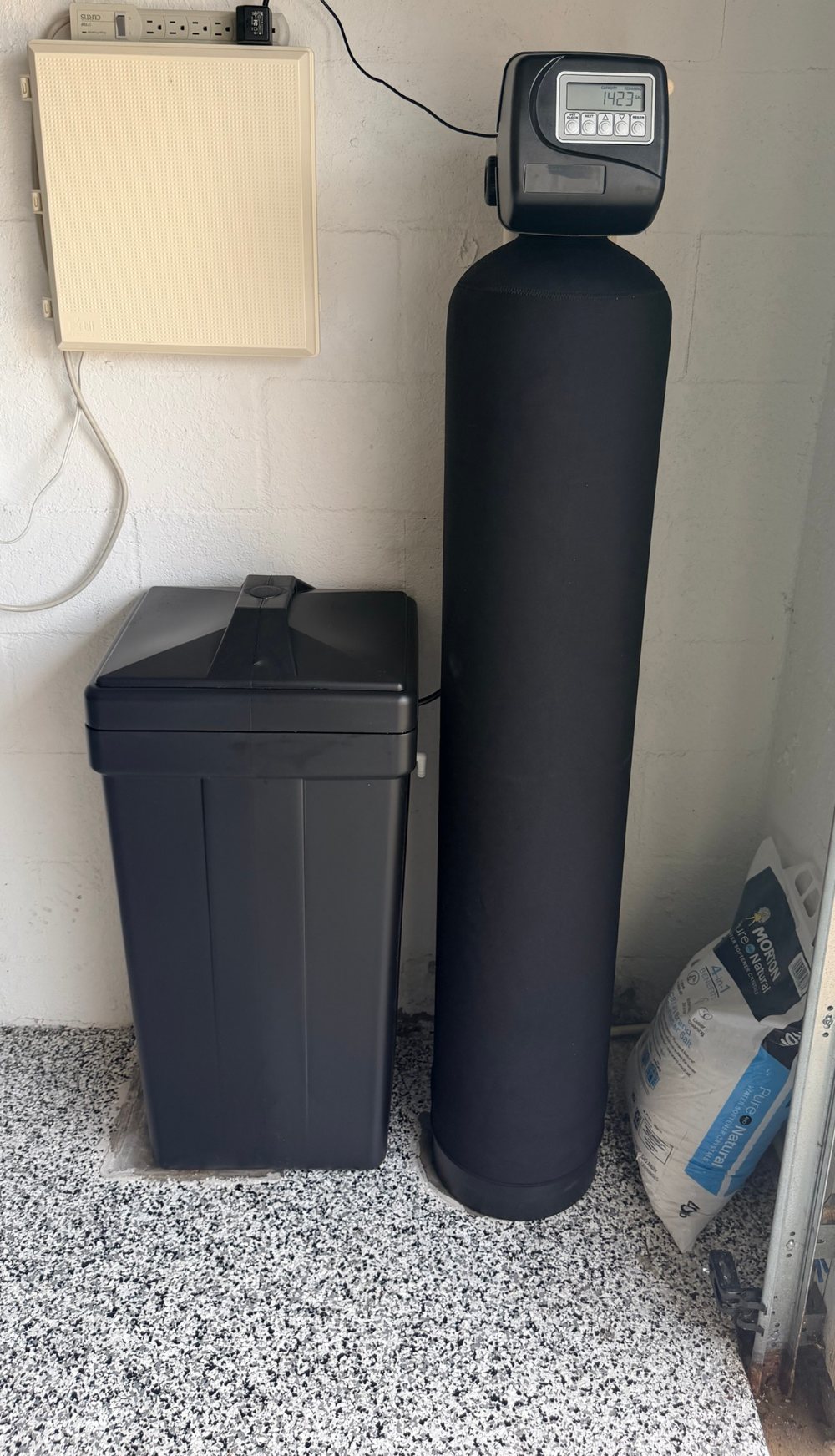
What a salt-based softener does
A softener runs your water through a tank of resin beads. The beads hold sodium; as hard water passes over them, calcium and magnesium trade places with the sodium. What comes out the other side has most of the hardness removed. Every so often the softener regenerates: it rinses the resin with salt water from the brine tank, flushes the captured hardness to the drain, and starts over.
You can see and feel the difference. Soap lathers, glass dries without the white film, and a hardness test strip at the tap reads near zero. A metered valve regenerates based on how much water you’ve actually used, not on a timer, which keeps salt and water use down.
What a salt-free conditioner does
A TAC conditioner uses a media that turns dissolved hardness into tiny crystals. The crystals stay suspended in the water and are less likely to bond to pipes, heating elements and fixtures. No salt, no brine tank, and usually no drain line. The media gets replaced on the manufacturer’s schedule.
The key point: the calcium and magnesium are still in the water. It isn’t softened, and it won’t feel like soft water. Where water dries on glass or a faucet, the minerals are still there to leave spots. What it’s meant to reduce is hard scale building up inside the plumbing and the water heater.
You’ll sometimes see these sold as “salt-free softeners.” It’s a common phrase, but it isn’t accurate. Conditioner is the right word.
How to tell whether each one is working
This is where people get confused, and where a lot of salt-free systems get blamed for something they were never meant to do.
Hardness test strip
Softener: reads near zero after. Salt-free conditioner: reads about the same before and after, because the hardness is still there.
TDS meter
Softener: about the same, because it swaps hardness for sodium. Salt-free: about the same. Neither lowers TDS. Reverse osmosis does.
Scale
This is how you judge a salt-free conditioner. Check showerheads, faucet aerators and the water heater over several months.
Feel and spots
A softener changes both. A salt-free conditioner doesn’t change the feel of the water, and spots can still form where water dries.
If someone tests your salt-free system with a hardness strip and tells you it has “stopped working,” that strip would have read the same on the day it was installed. More on TDS in does a water softener lower TDS?
What this means on Manatee County water
Manatee County’s 2025 report puts hardness at 106 to 279 mg/L — about 6 to 16 grains per gallon, moderately hard to very hard depending on the blend of reservoir and aquifer water that day. Nearly all of Lakewood Ranch is on the same water. At the upper end of that range, most people who want the soft-water feel and spot-free glass end up with a salt-based softener.
The county also disinfects with chloramine, with a highest running annual average of 3.3 ppm in 2025. Chlorine in any form wears out softener resin over time, so on this water we put catalytic carbon ahead of a softener. See chlorine vs chloramine in Manatee County water.
City of Bradenton water is a different case. The city doesn’t publish a hardness number, and its 2025 report shows TDS of 550 mg/L and sulfate of 288 mg/L, both above EPA’s secondary guidelines. Neither a softener nor a conditioner changes those. If taste is the complaint there, the fix is reverse osmosis at the kitchen sink.
The sodium question
A softener adds roughly 7.5 mg of sodium per quart for each grain of hardness it removes. On 10-grain water, that’s about 75 mg per quart. For comparison, Manatee County’s water already carries about 15 mg/L of sodium before any softener.
Two ways to handle it if it matters to you. Most softeners can regenerate with potassium chloride instead of salt; it costs more per bag. Or put reverse osmosis at the kitchen sink, which takes most of the sodium back out of your drinking and cooking water. If a doctor has you watching sodium, take these numbers to them; we’ll give you your actual hardness so the math is yours, not a guess.
Which one we’d point you to
A salt-based softener, if…
you want soap to lather, glass and shower doors without the film, and water that feels soft; your hardness is toward the top of the county range; you have a drain and an outlet where the system goes.
A salt-free conditioner, if…
your main concern is scale in the water heater and plumbing; you don’t want to carry salt or add sodium; you’re fine with the water feeling the same and some spotting on glass.
And sometimes neither. If your test comes back soft, or the hardness doesn’t bother you, you don’t need either one, and we’ll say so.
On cost: the Hydrology Essentials softener starts at $2,995. A whole-home softener with catalytic carbon runs $3,500–$4,500. Salt-free conditioners we quote after the test, and Puronics equipment is call-for-pricing, because the manufacturer’s advertised-price policy is a condition of carrying the line. The full breakdown is in what a water softener costs in Florida.
If you’re still weighing it, ask. We enjoy curious clients, because we enjoy educating and answering questions. Our which water system page walks through the choice too.
Common questions
Does a salt-free water softener actually soften water?
No. A salt-free conditioner leaves calcium and magnesium in the water and changes how they behave so less scale sticks to surfaces. A hardness test reads about the same before and after. Only a salt-based softener removes hardness.
How do I know my salt-free system is working?
Judge it by scale, not by a test strip. A hardness strip and a TDS meter read about the same before and after a salt-free conditioner. Look at showerheads, faucet aerators and your water heater over several months.
How much sodium does a water softener add?
Roughly 7.5 mg per quart for each grain of hardness removed. On 10-grain water that is about 75 mg per quart. A reverse osmosis system at the kitchen sink takes most of it back out of your drinking water.
Does either one lower TDS?
No. A softener swaps hardness for sodium and a salt-free conditioner leaves the minerals in place, so TDS stays about the same with both. Reverse osmosis is what lowers TDS.
Can I use potassium instead of salt in a softener?
Yes. Most softeners can regenerate with potassium chloride instead of sodium chloride. It costs more per bag, and the softener’s settings may need adjusting.
Which one does Hydrology install?
Both. We test your water first, then recommend the one that fits your hardness, your plumbing and what you want to fix, including telling you when you don’t need either.
Want to know which one fits your house? Our free water test checks hardness, chlorine, pH and TDS at your tap. We explain every number, then recommend a softener, a conditioner or nothing at all. Book online or call 941-266-8991.
Related: Does a water softener lower TDS? · What a water softener costs in Florida · Chlorine vs chloramine in Manatee County water · Does reverse osmosis remove PFAS? · Which water system do I need? · 7 questions to ask before buying a softener · Softener vs whole-house filter
Sources: Manatee County Utilities 2025 Water Quality Report and Additional Water Quality Information 2025; City of Bradenton 2025 Water Quality Report; U.S. Geological Survey hardness classification; Penn State Extension (sodium added by water softeners); Lakewood Ranch 2025 fact sheet.
