
Chlorine vs. Chloramine: What’s Actually in Your Manatee County Water?
Aug 14, 2026Manatee County uses chloramine, not plain chlorine. Chloramine is chlorine bonded with ammonia, and it holds up longer in the pipes — the county’s 2025 report shows a highest running annual average of 3.3 ppm. The part that matters at home: ordinary activated carbon handles free chlorine well but is slow on chloramine. For Manatee County, Lakewood Ranch and City of Bradenton water, the media built for the job is catalytic carbon, sized for more contact time.
What’s the difference between chlorine and chloramine?
Every public water system has to keep a disinfectant in the water all the way to your faucet. Utilities choose between two main options.
Free chlorine
Chlorine on its own. It works fast and it’s reactive, which also means it fades as water travels through miles of pipe. It’s easy to smell, and ordinary activated carbon takes it out quickly.
Chloramine
Chlorine combined with ammonia. It’s more stable and lasts longer in the pipes. EPA notes that some utilities switched to it to meet disinfection byproduct requirements. It’s milder to smell but harder to take out.
Neither one is a sign that something is wrong with the water. The disinfectant is supposed to be there. What changes is how you treat it at home if you don’t want it at your taps or in your softener.
Who uses what around Bradenton
It depends on your utility, not your zip code. Here’s what each one’s own report or notice shows.
- Manatee County Utilities — chloramine. Highest running annual average 3.3 ppm in the 2025 report, with individual samples ranging from not detected to 5.3 ppm. The maximum residual disinfectant level is 4.0 ppm, measured as a running annual average, which is why a single sample can read above it. The county’s water is a blend of Lake Manatee Reservoir surface water and Floridan aquifer groundwater.
- Lakewood Ranch — nearly all of it is Manatee County water, so the same numbers apply. The exception is the Waterside village on the Sarasota County side.
- City of Bradenton — a separate utility, supplied from the Bill Evers Reservoir and aquifer storage recovery wells. Its 2025 report lists the disinfectant as “chlorine and chloramines,” with a highest running average of 3.41 ppm. More on the city’s water on our Bradenton city water page.
- City of Sarasota — free chlorine year-round.
- Pinellas County Utilities — chloramine normally, with a temporary switch to free chlorine. The 2026 run is September 21 through October 10, 2026.
Why the water smells like a pool, and why it sometimes gets stronger
That swimming-pool smell is the disinfectant. Chloramine is milder than free chlorine, but plenty of people still notice it, especially in a hot shower or in the first glass of the morning.
If you’re in Pinellas County and the smell gets stronger for a few weeks, that’s the scheduled free-chlorine conversion. Free chlorine is easier to smell and taste than chloramine, so the water smells stronger until the conversion ends and the utility goes back to chloramine. It’s temporary, and the utility announces the dates ahead of time.
Why ordinary carbon isn’t enough for chloramine
Standard activated carbon is very good at free chlorine. The chlorine reacts on the carbon surface almost as soon as the water touches it. Chloramine reacts far more slowly. With ordinary carbon, most of the water has already passed through before much of the chloramine is gone.
Catalytic carbon is activated carbon whose surface has been treated to be much more reactive, so it breaks chloramine down instead of just trying to hold onto it. Even then, it needs more contact time than chlorine does. In practice that means enough carbon in the tank for your household’s flow rate, not a thin cartridge the water rushes through. Fridge and pitcher filters have very short contact time and are built mainly for chlorine taste. We go into more detail in catalytic carbon vs activated carbon.
The flip side, and it may save you money: on City of Sarasota water, which uses free chlorine all year, ordinary activated carbon does the job. Catalytic carbon isn’t needed there, and we won’t quote it.
Why carbon goes in front of a water softener
Most homes in Manatee County also have hard water — 106 to 279 mg/L in the county’s 2025 report, or about 6 to 16 grains per gallon. Chlorine in any form wears out softener resin over time. So when we install a softener on chloramine water, carbon goes ahead of the resin, and on Manatee County water that carbon is catalytic.
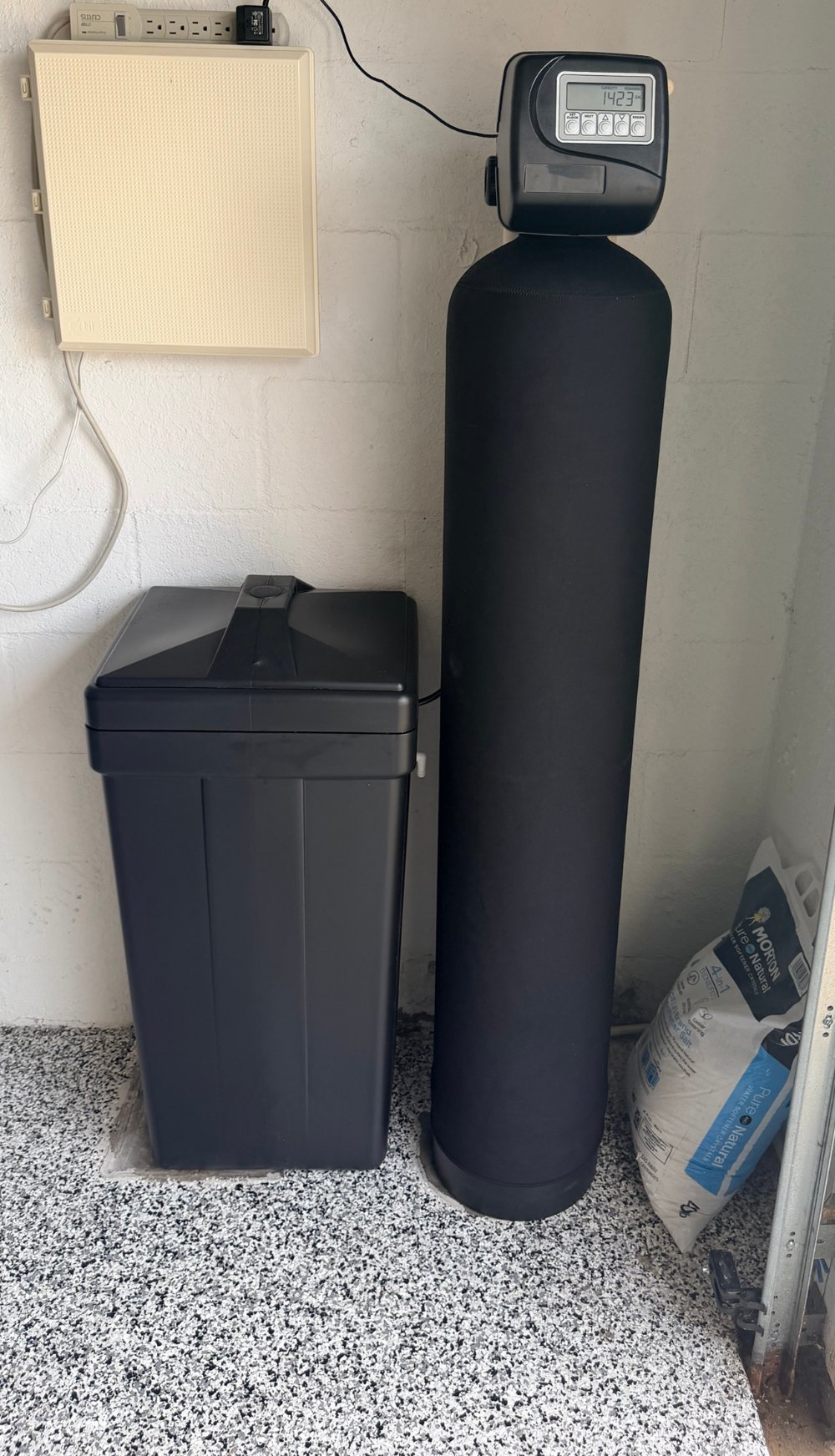
Two ways we set that up:
- Hydrology Essentials, from $2,995. Our value-built system: one tank holding 1 cubic foot of softening resin, 0.25 cubic feet of catalytic carbon and 0.25 cubic feet of activated carbon, on a metered Clack valve.
- Whole-home softener plus catalytic carbon, $3,500–$4,500. More carbon and more contact time, for larger homes or heavier use.
One note on certifications. The whole-home Puronics Defender 30C and Hydronex iGen C are certified to NSF/ANSI 42, 44 and 372. None of those is a chloramine-reduction certification, and we won’t tell you otherwise. What handles chloramine is catalytic carbon with enough contact time, which is a sizing question. That’s why we test first. Puronics pricing is call-for-pricing; the manufacturer’s advertised-price policy is a condition of carrying the line.
Do you actually need to treat it?
Not necessarily. Chloramine is there on purpose, and the utility publishes its results every year. Whether you treat it is about what you want at your taps.
- If the smell doesn’t bother you and you don’t have a softener, you may not need anything for it.
- If you only care about drinking water, a reverse osmosis system at the kitchen sink, with its own carbon stages, covers that one tap. It won’t change the showers.
- If the showers bother you, or you’re putting in a softener anyway, whole-home catalytic carbon makes sense. For a softener on chloramine water, it’s what keeps the resin working.
If you keep fish, EPA notes that chloraminated water may need additional treatment for specialized uses such as aquariums and kidney dialysis. That’s a conversation for your aquarium supplier or care team, not a reason to buy a whole-house system.
Questions about any of this are welcome. We enjoy curious clients, because we enjoy educating and answering questions.
Common questions
Does Manatee County use chlorine or chloramine?
Chloramine. The county’s 2025 report shows a highest running annual average of 3.3 ppm, with individual samples ranging from not detected to 5.3 ppm.
Why does my water smell like a swimming pool?
That’s the disinfectant. Chloramine is milder to smell than free chlorine, but many people still notice it, especially in a hot shower.
Will a regular carbon filter remove chloramine?
Ordinary activated carbon handles free chlorine well but works slowly on chloramine. Catalytic carbon is the media built for chloramine, and it needs more contact time, so the tank has to be sized to your household’s flow.
Why does Pinellas County water smell stronger during the chlorine conversion?
Pinellas County Utilities normally uses chloramine and runs a temporary switch to free chlorine. The 2026 run is September 21 to October 10, 2026. Free chlorine is easier to smell, so the water smells stronger until the switch ends.
Do I need catalytic carbon on City of Sarasota water?
No. The City of Sarasota uses free chlorine year-round, so ordinary activated carbon handles it. Catalytic carbon is for chloramine water like Manatee County’s.
Can I use chloraminated water in an aquarium?
EPA notes that chloraminated water may need additional treatment for specialized uses such as aquariums and kidney dialysis. Ask your aquarium supplier about a water conditioner made for chloramine.
Not sure what’s in your water? Our free water test checks chlorine, hardness, pH and TDS at your tap, and we explain each number before we recommend anything — including when the answer is that you don’t need a system. Book online or call 941-266-8991.
Related: Catalytic carbon vs activated carbon · Salt-free vs salt-based softeners · What a water softener costs in Florida · Does reverse osmosis remove PFAS? · Bradenton city water · Softener vs whole-house filter
Sources: Manatee County Utilities 2025 Water Quality Report and Additional Water Quality Information 2025; City of Bradenton 2025 Water Quality Report; City of Sarasota Utilities; Pinellas County Utilities temporary free-chlorine conversion notice (2026); U.S. EPA, “Chloramines in Drinking Water” and “Common Health Questions Related to Monochloramine”; Lakewood Ranch 2025 fact sheet.
