
Reverse Osmosis Systems in Florida: A Buyer’s Guide
Oct 31, 2026Short answer: an under-sink reverse osmosis (RO) system is the most effective drinking-water filter a Florida home can buy, because it is the only common kitchen filter that reduces dissolved solids, not just taste and odor. In Florida, buy one that is certified to NSF/ANSI 58, put it behind a carbon stage that can handle chloramine (most of the Suncoast is on chloramine, not chlorine), and if PFAS is your concern, insist on a system certified to NSF/ANSI 53 for PFOA and PFOS by name. Tank systems cost less and need no power; tankless systems flow faster and need an outlet. Everything else is details, and the details are below.
We install and service reverse osmosis systems across Manatee, Sarasota, Hillsborough, Pinellas and Charlotte counties, on city water and on wells. This guide is what I tell people at the kitchen table before they buy: what Florida water actually looks like, what the certifications mean, tank versus tankless, what drives the installed price, and what the system needs from you afterward.
What reverse osmosis does that other filters don’t
A pitcher, a fridge filter and a faucet filter are all carbon. Carbon is good at chlorine taste and odor and, with the right media, at chloramine and some organics. It does nothing for dissolved solids: the minerals, salts and metals that are in solution. Reverse osmosis pushes water through a membrane with openings small enough that most dissolved solids stay on the other side and go down the drain. That is why an RO faucet typically reads a fraction of the tap’s total dissolved solids (TDS), and why RO water tastes different from filtered tap water.
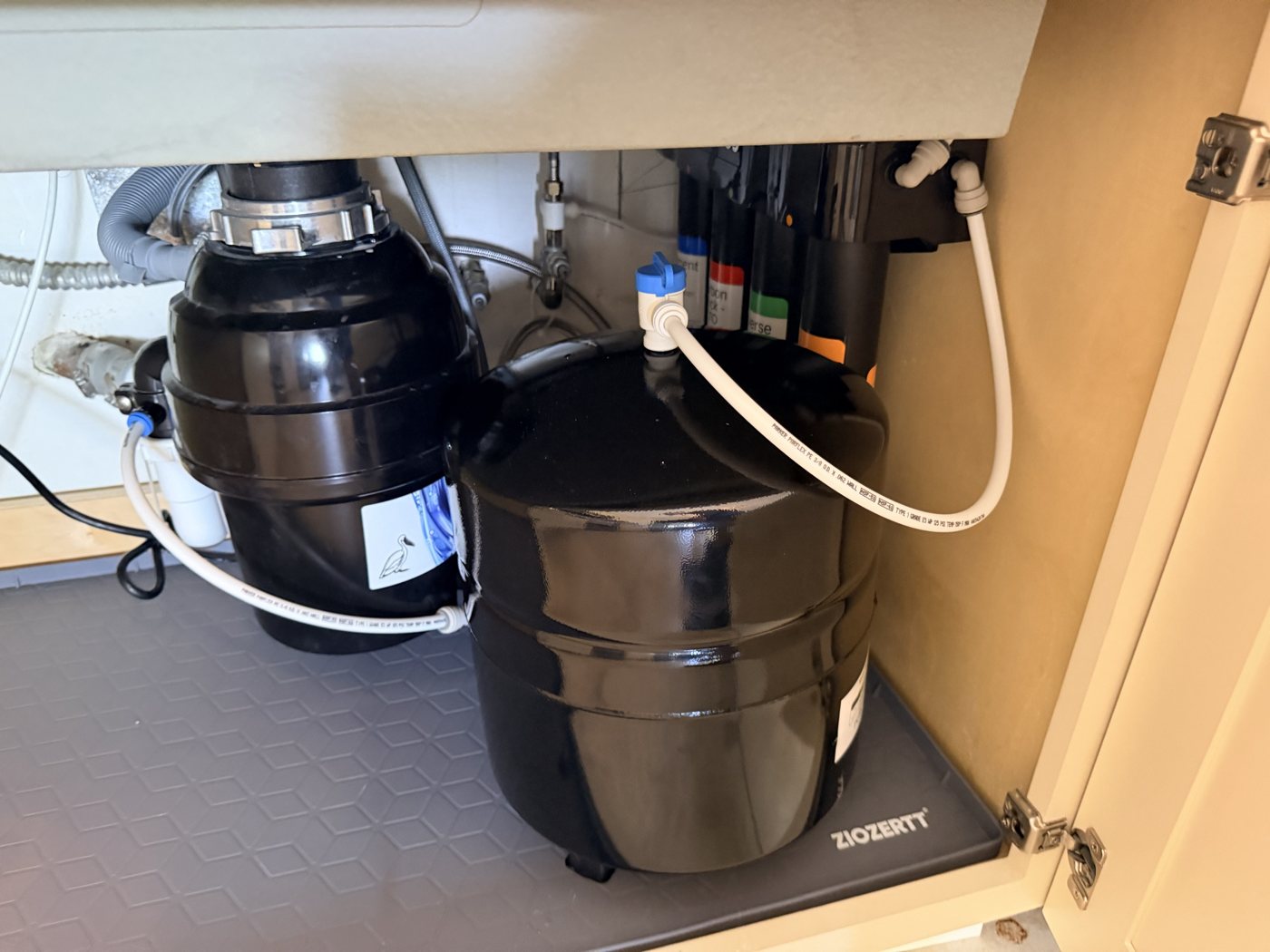
A typical under-sink RO system has four or five stages: a sediment filter, one or two carbon filters, the membrane, and a final carbon polish. Some add an alkaline or remineralizing stage at the end that puts a little calcium and magnesium back for taste. If yours has one, the TDS meter will read higher at the faucet than a system without it. That is the stage working, not the membrane failing.
If you are weighing RO against a fridge or pitcher filter, we wrote that comparison separately: Reverse osmosis vs. a fridge or pitcher filter.
What Florida water needs from an RO system
Florida water is not one thing. The three things that matter for an RO purchase here are the disinfectant, the hardness, and whether you are on a well.
Most Suncoast utilities use chloramine, not chlorine
Manatee County, Sarasota County, Hillsborough County’s South-Central system, Pinellas County, St. Petersburg and Charlotte County all disinfect with chloramine. Manatee County’s 2025 water quality report shows a chloramine residual of 3.3 ppm with a range up to 5.3 ppm; Sarasota County shows 3.5 ppm; Hillsborough South-Central 3.8 ppm. The City of Sarasota is the exception and runs free chlorine.
This matters because RO membranes are damaged by both chlorine and chloramine, and the carbon pre-filter in front of the membrane is what protects it. Chloramine is more stubborn than chlorine and needs more contact time or catalytic carbon to break down. A system designed around chlorine that gets fed chloramine will chew through its membrane early. When we size a system for a chloramine utility we treat the carbon stage as the membrane’s bodyguard, not an afterthought. More on the chemistry here: Chlorine vs. chloramine in Manatee County water.
Hardness scales membranes
Manatee County’s own 2025 report lists total hardness up to 279 ppm as calcium carbonate, which is 16 grains per gallon. Water that hard scales an RO membrane the same way it scales a shower door, and a scaled membrane makes less water and rejects less. If the house has a softener, the RO lives longer and the membrane does less work. If it doesn’t, an RO still works, but expect shorter membrane life and plan the pre-filtration accordingly. The softener and the RO are a team: the softener protects the house and the membrane, the RO handles what you drink. The full explanation is in Does a water softener lower TDS?
Wells are a different conversation
On a well, RO comes last. Iron, sulfur and bacteria have to be dealt with ahead of it or they foul the membrane and the pre-filters in months. The order we design for is oxidize or disinfect first, filter second, soften third, then RO at the sink. Near the coast, wells with saltwater intrusion or very high dissolved solids are the one case where whole-home RO makes sense; everywhere else, RO belongs at the kitchen sink and the rest of the house gets a softener and filtration. Our iron guide and sulfur guide cover the front end of that system.
Tank or tankless?
Tank RO
The classic setup: a 3-gallon-class pressure tank under the sink that fills slowly and delivers on demand.
- No electricity needed
- Lower purchase price, simpler to service
- Fills slowly; a big pot can drain the tank
- Tank takes real cabinet space and its air bladder needs checking every year or two
Tankless RO
A pump pushes water through a larger membrane on demand, so there is no storage tank.
- Faster, steadier flow at the faucet
- Frees up cabinet space; no stale tank water
- Needs an outlet under the sink
- Higher purchase price; pump is one more part
For most families a tank system is the right call. If you cook a lot, fill a lot of bottles, or hate the under-sink tank, tankless is worth the step up. We install both: the Puronics Micromax 7000 and Micromax 8500 are tank systems, and our tankless RO is the on-demand option. If a tank system loses pressure later, it is usually the air charge, and that is a ten-minute check: RO tank lost pressure?
The certifications are the whole point
Any box can print a big percentage on the front. The only claims that mean anything are the ones tested by an independent lab under an NSF/ANSI standard, with the contaminant listed by name. These are the ones to look for on an RO system in Florida:
| Standard | What it certifies | Why it matters here |
|---|---|---|
| NSF/ANSI 58 | Reverse osmosis systems: TDS reduction plus named contaminants such as lead, arsenic, cysts, nitrates | The baseline. If a system is not certified to 58, it is not a certified RO system. |
| NSF/ANSI 42 | Aesthetic effects: chlorine taste and odor, particulates | Covers the carbon stages. Does not by itself cover chloramine; ask. |
| NSF/ANSI 53 | Health effects: lead, VOCs, PFOA/PFOS and others, each listed individually | If PFAS is why you are buying, the system must list PFOA/PFOS under 53. “RO reduces PFAS” in general is not a certification. |
| NSF/ANSI 401 | Emerging compounds: certain pharmaceuticals, herbicides, BPA | Nice to have on city water drawn from rivers and reservoirs, which is most of the Suncoast. |
| NSF/ANSI 372 | Lead-free materials | Confirms the faucet and fittings themselves are not adding lead. |
On our own lineup: the Micromax 7000 is certified to NSF/ANSI 42, 58 and 372. The Micromax 8500 adds 53 (including PFOA/PFOS and VOCs) and 401. If a customer tells me PFAS is the reason for the call, the 8500 is the only one of the two I will put in. The details, including what the federal PFAS limits mean and what the local utility reports show, are in Does reverse osmosis remove PFAS?
What drives the installed price in Florida
Installed prices for a quality under-sink RO in our area vary more by the install than by the box. These are the things that move the number, roughly in order:
- Certification level. A system certified to 53 for PFOA/PFOS and to 401 costs more to build and test than a 42/58 system.
- Tank vs. tankless. Tankless systems carry a pump and a larger membrane.
- Where the water goes. Just the RO faucet, or also the fridge and ice maker? A fridge line is a common add and worth doing on install day rather than later.
- The faucet and the countertop. Drilling granite or quartz for a dedicated faucet takes the right bit and the right person. Some sinks have a spare hole; most don’t.
- Drain and plumbing condition. An RO needs a drain connection. Old shutoffs, corroded supply lines and crowded cabinets add time.
- Pre-treatment. On a well, or on unsoftened hard water, the RO may need extra sediment or carbon capacity in front of it.
We don’t publish equipment prices online, because the right number depends on your water and your kitchen. What we do instead is come out, test the water at your sink for free, and quote the whole job in writing before anything is ordered. Financing through Synchrony and Wisetack is available on every system we install; the pre-approval takes about two minutes and doesn’t affect your credit. If you are also looking at a softener, the pricing logic is similar: What a water softener costs in Florida.
How much water does RO use?
An RO membrane rinses itself with the water it rejects, and that rinse water goes down the drain. The EPA puts a typical under-sink system at five gallons or more to the drain for every gallon of drinking water; systems that earn the WaterSense label are held to 2.3 gallons or less. For a household that drinks and cooks with a few gallons a day, that is a small line on the water bill. It is the reason RO belongs at the kitchen sink and not on the whole house, where every shower and laundry load would run through a membrane and most of it would go down the drain.
What the system needs from you afterward
- Pre- and post-filters: about once a year. Carbon and sediment cartridges age on time as much as on gallons, and in a chloramine area the carbon is what is protecting the membrane. Here is the real filter-change schedule and the signs you’ve waited too long.
- Membrane: every three to five years, sooner on hard unsoftened water. A rising TDS reading at the RO faucet is the tell.
- Tank air charge: check it at every filter change. Slow flow with full filters is almost always a tank that lost its air.
- Snowbirds: if the house sits empty for the summer, shut the RO’s supply valve before you leave and flush the system and change the filters when you come back. Water that sits in a warm cabinet for five months is not water you want to drink first thing.
- Sanitize the system when you change the membrane. Our Platinum Care plans cover filters, sanitizing and the tank check on a schedule so none of this is on your calendar.
Do you actually need one?
If you buy bottled water for the house, yes, an RO pays for itself and you stop hauling cases. If you already have a softener and the water tastes fine to you, an RO is a quality-of-life upgrade for drinking, coffee, ice and cooking, not a necessity. If PFAS, lead or the utility’s disinfection byproducts are on your mind, an RO certified to the right standard is the most direct answer at the tap. And if you are on a well, the RO is the last step, not the first; fix the iron, sulfur and bacteria ahead of it or you will be buying membranes.
The honest way to decide is to test. We test at the kitchen sink for free, explain the numbers, and if the water doesn’t need anything we say so.
Common questions
Does reverse osmosis soften water?
An RO reduces the calcium and magnesium in the water it makes, so RO drinking water is low in hardness. It does not soften the rest of the house, and hard feed water shortens membrane life. A softener handles the house; the RO handles the drinking water.
Does reverse osmosis remove PFAS?
Reverse osmosis can reduce PFAS, but only a system certified to NSF/ANSI 53 for PFOA and PFOS has been independently tested for it. On our lineup that is the Puronics Micromax 8500. The Micromax 7000 is not certified for PFAS.
Tank or tankless: which is better in Florida?
Tank systems are simpler, need no power and cost less; they suit most families. Tankless systems flow faster, free up cabinet space and need an outlet under the sink. Florida water does not change the choice; how much water you draw at the kitchen sink does.
Can the RO feed my refrigerator and ice maker?
Yes, and it is a common add. The line is run from the RO’s post-filter to the fridge. Fridge ice from RO water is clearer and the fridge’s own filter lasts longer.
How much water does an RO system waste?
The EPA estimates a typical under-sink RO sends five gallons or more to the drain per gallon produced; WaterSense-labeled systems are held to 2.3 gallons or less. For drinking and cooking volumes, that is a small amount on the bill.
How often do RO filters need changing?
Pre- and post-filters about once a year, the membrane every three to five years. On chloramine city water the carbon pre-filter protects the membrane, so don’t stretch the schedule.
Do I need an RO if I already have a water softener?
Not necessarily. A softener does not reduce dissolved solids or chlorine taste; an RO does. If you want better-tasting drinking water or a certified answer to PFAS or lead at the tap, add the RO. If the softened water tastes fine to you, you may not need it.
Is RO worth it on a well?
Yes, once the well water is treated ahead of it. Iron, sulfur and bacteria must be handled before the membrane or the system fouls quickly. On wells with saltwater intrusion, whole-home RO can be the only real fix.
Not sure which system fits your water? We test at your kitchen sink for free, explain what we find in plain English, and quote the whole job in writing. No cost, no pressure.
Related: Reverse osmosis systems in Bradenton · Puronics Micromax 8500 · Puronics Micromax 7000 · Tankless RO · Does RO remove PFAS? · RO vs. fridge filter
Sources: Manatee County Utilities 2025 Water Quality Report and Additional Water Quality Information sheet (chloramine residual, hardness, TDS); Sarasota County 2025 Consumer Confidence Report; Hillsborough County South-Central 2025 Water Quality Report; Pinellas County 2024 Consumer Confidence Report; U.S. EPA WaterSense specification for point-of-use reverse osmosis systems; NSF/ANSI standards 42, 53, 58, 401 and 372; WQA certification listings for the Puronics Micromax 7000 and 8500.
